

Nexus
Production Management
Manage the full lifecycle of orders and print production across every site — built to scale and grow globally without complexity.
See details
What We Offer
Each Cloudstore solution is dedicated to a distinct market or application within the print industry — from production management and fulfilment to print-on-demand, art-on-demand and OEM partnerships — so a business can adopt exactly what it needs today and add more as it grows, without ever switching to different underlying technology.
Nexus
Manage the full lifecycle of orders and print production across every site — built to scale and grow globally without complexity.
See detailsPulse
Manage artwork delivery on demand and print it anywhere in the world, sustainably and consistently — built to run securely and efficiently.
See detailsOrbit
Access fulfilment capacity, geographic reach and product range anywhere in the world — built to extend your fulfilment network on demand.
See detailsOpus
Protect original artwork for artists, publishers and galleries, opening secure access for wall art businesses to sell — built to extend reach on both sides.
See detailsIngress
Power online selling experiences — access content, automate product configuration, manage orders and fulfil anywhere in the world.
See detailsAtelier
Extend product ranges into interior décor, wallpaper and textiles, with visualisation capabilities — produced and fulfilled globally.
See detailsRosetta
Submit large format print jobs from the cloud to any connected site or printer — with full control, analytics and a single point of access to every job.
See detailsAxiom
White-label any solution or technology, or draw on Cloudstore's experience to help design and launch a new print commerce operation.
See details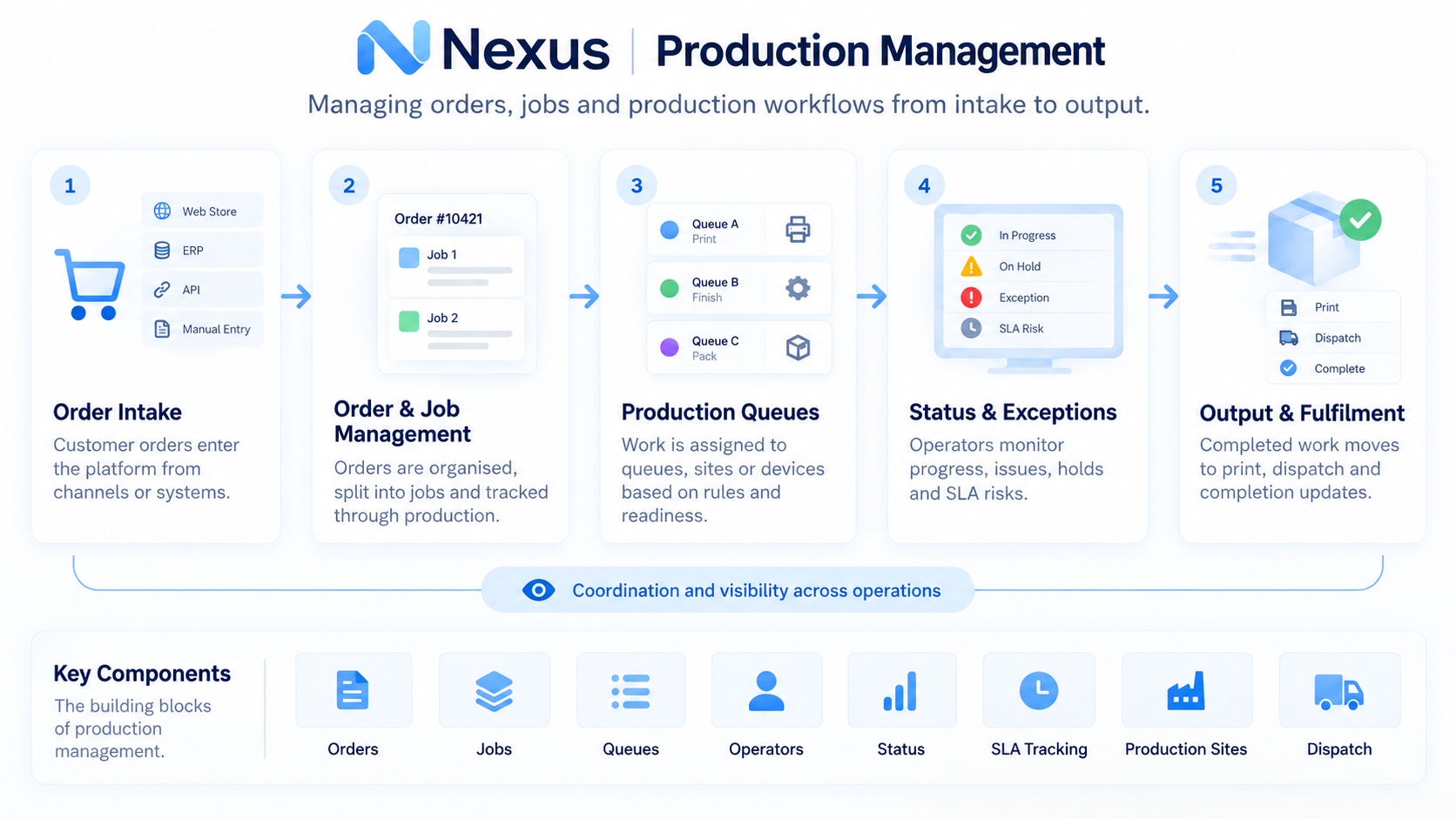
Nexus manages the full lifecycle of a production order end-to-end, from submission to shipment. Orders arrive from web stores, ERPs, APIs or manual entry, and are organised into individual jobs that stay tracked through every stage of production. From there, work is assigned to the right queue — print, finishing or packing — based on site, device and readiness, so nothing waits on a queue that isn't ready for it.
Throughout, operators get a live view of progress, holds, exceptions and SLA risk, so issues get caught before they become missed deadlines. Once work is complete, Nexus hands off to print, dispatch and completion — with status flowing back across every connected order, job, queue, operator, production site and shipment the whole way through.
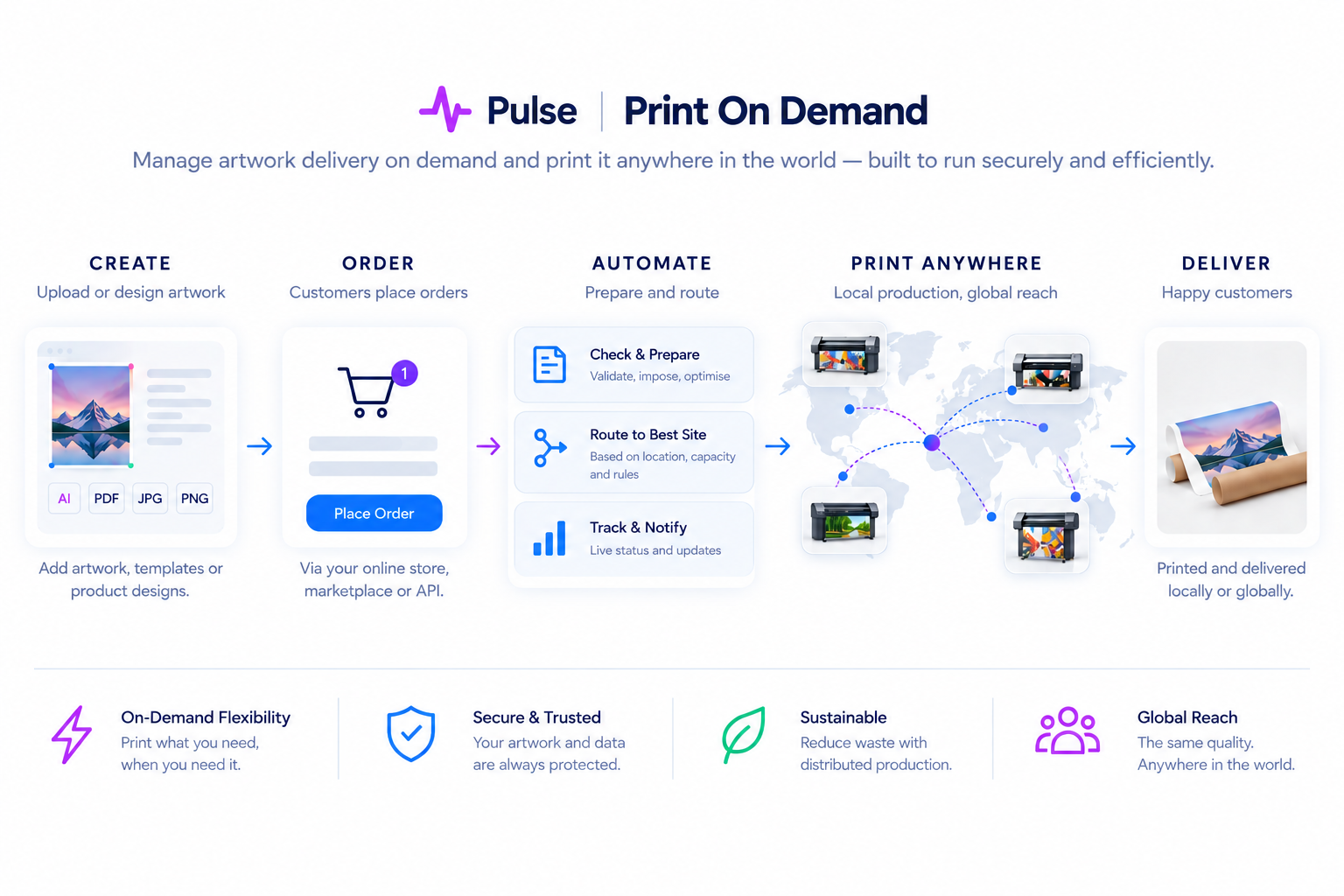
Pulse handles the full path from artwork to finished print without any physical stock along the way. Artwork is uploaded or designed in the formats already in use, an order comes in through a connected store, marketplace or API, and Pulse checks, prepares and routes each job automatically to the best available production site based on location, capacity and rules.
Because production happens locally wherever the order lands, the same job can be printed and delivered close to the customer anywhere in the world, with live status and tracking throughout. Artwork and data stay protected the whole way through, and producing only what's ordered — at the site nearest to the customer — keeps the process both sustainable and consistent, wherever in the world it happens.
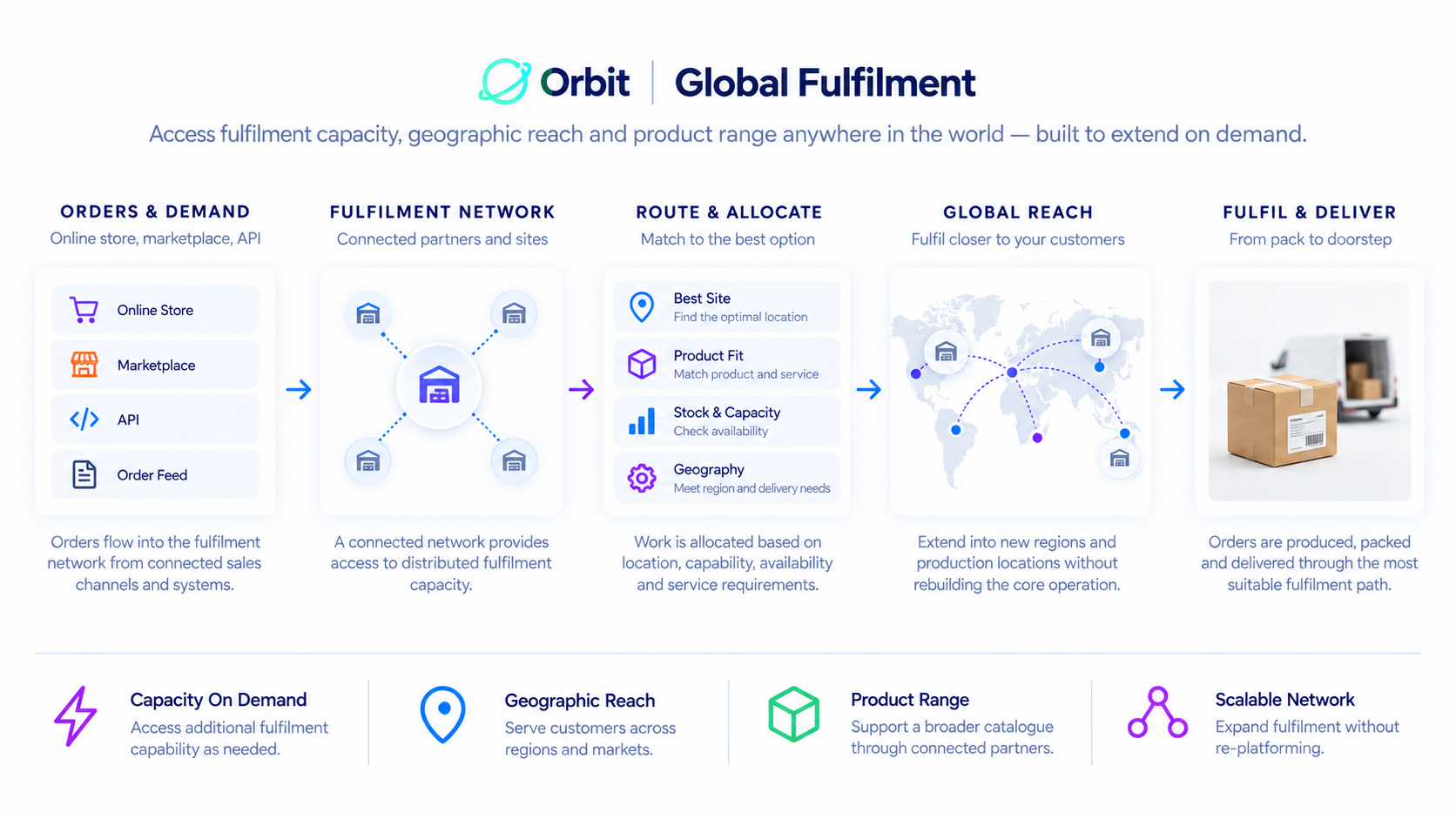
Orbit connects orders from online stores, marketplaces, APIs and order feeds into a wider network of fulfilment partners and sites, rather than relying on a single production location. Each order is routed and allocated automatically based on the best available site, product fit, stock and capacity, and regional delivery requirements — so work goes to whichever partner in the network is actually best placed to fulfil it.
That network can extend into new regions and product categories without rebuilding the core operation, giving access to additional fulfilment capacity, geographic reach and product range exactly when it's needed. From there, orders are produced, packed and delivered through whichever path gets them to the customer fastest — with the same network able to scale as more partners, sites and markets connect.
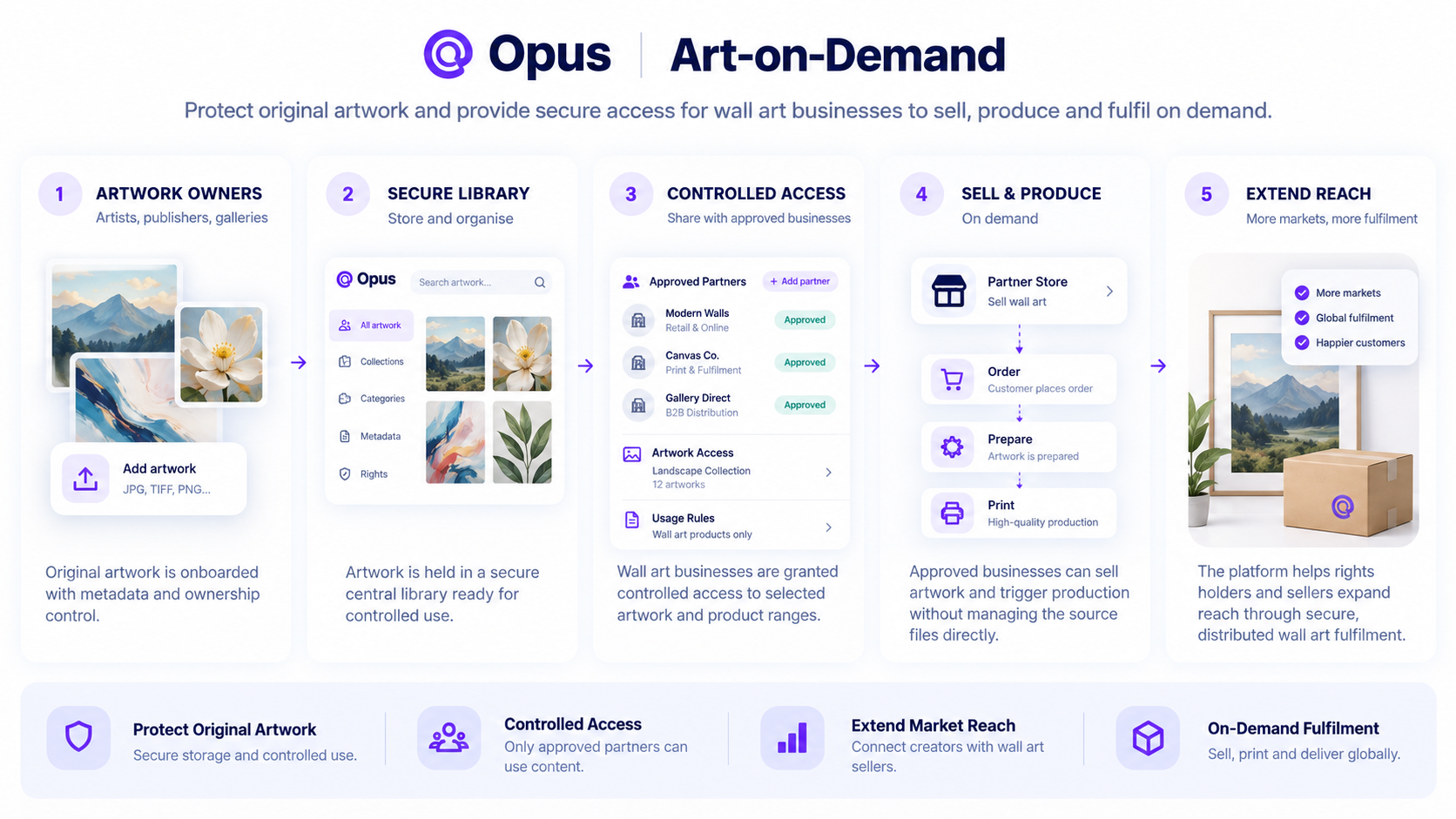
Opus lets artists, publishers, galleries, museums and image rights owners make high-value digital content available for print without ever releasing the original files. Artwork stays securely stored and streamed only at the point of production, so the value and control of the original never leaves the rights owner's hands, however many times it's printed.
On the other side, wall art businesses get secure access to a catalogue of high-value art they don't have to own, licence outright or store themselves — ready to offer, sell and print on demand as part of their own range. The same connection works both ways: rights owners reach more places their work can be sold, and wall art businesses reach a wider catalogue than they could source alone.
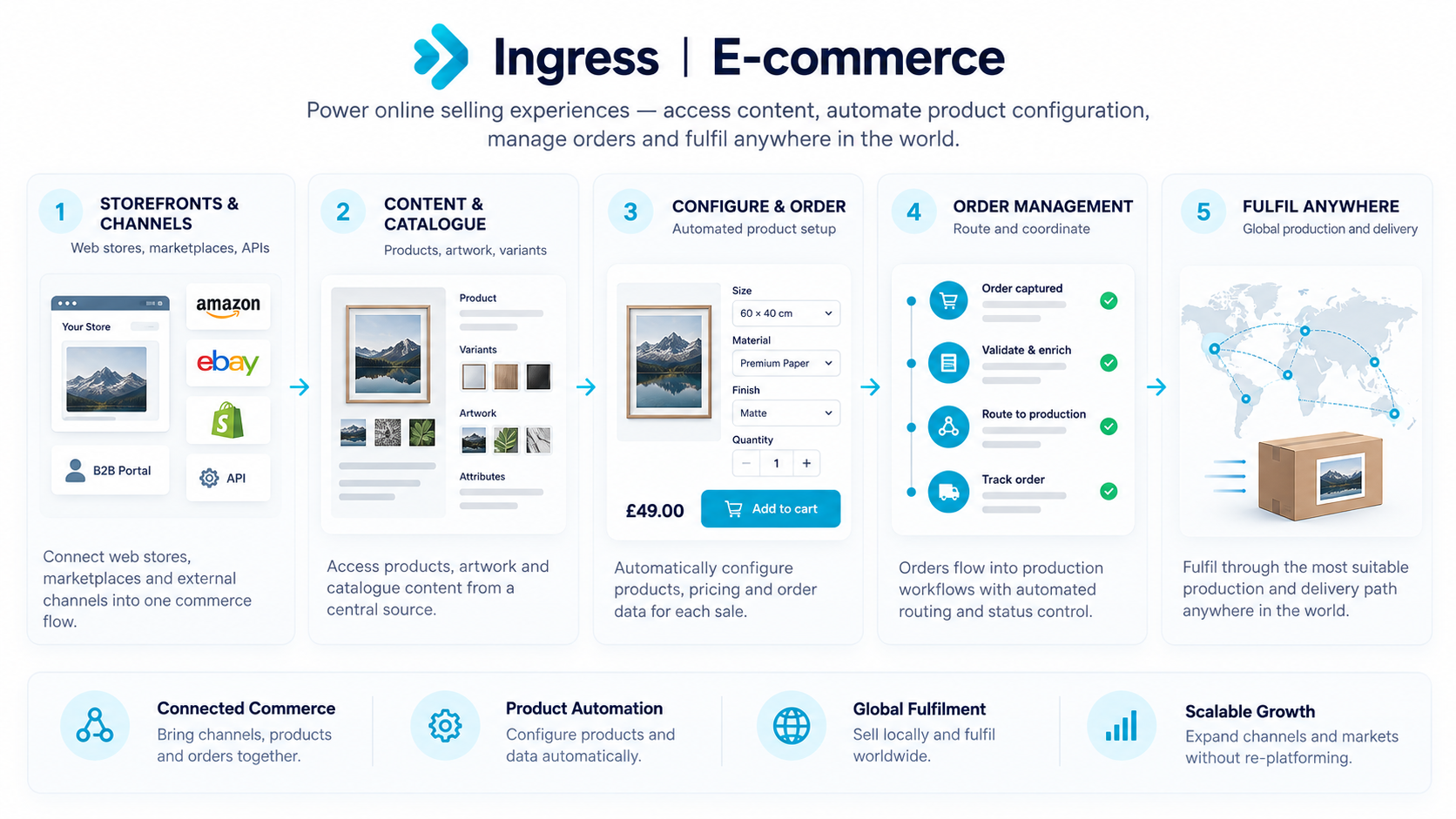
Ingress is built around bringing every part of online selling into one connected flow, rather than leaving channels, products and orders scattered across separate systems that need to be manually kept in sync. Product setup, pricing and order data are configured automatically as part of that same flow, so adding a new product or connecting a new channel doesn't mean rebuilding how orders reach production.
That same connected flow supports selling locally while fulfilling globally, routing each order to whichever production and delivery path suits it best, wherever the customer is. As more channels, markets and products join, Ingress is designed to grow with the business rather than needing to be re-platformed — the same foundation simply extends further.
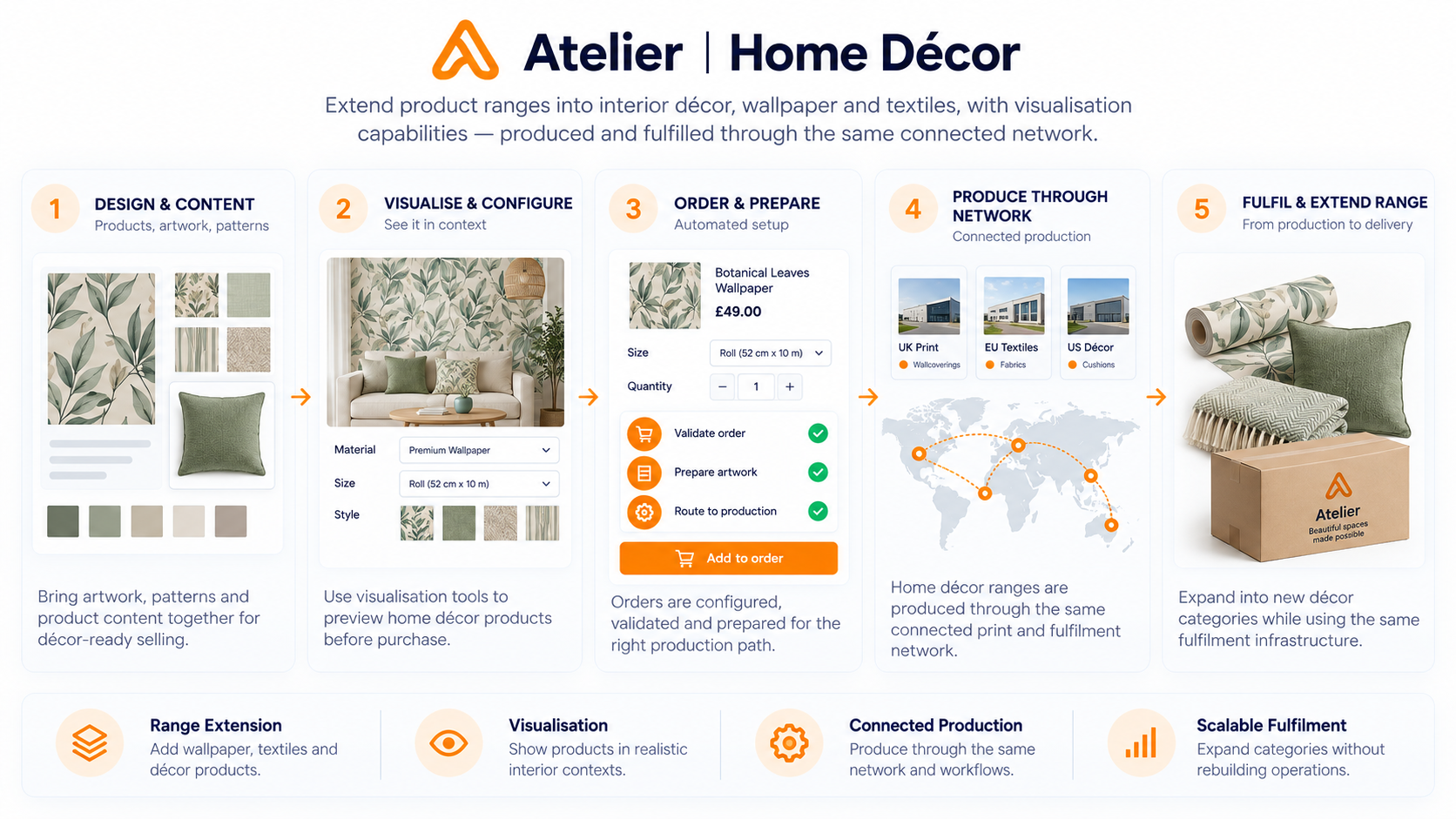
Atelier is built around extending any product catalogue into interior décor — wallpaper, textiles and related home products — without treating it as a separate business. Visualisation tools let customers see a chosen design in a realistic interior setting before they buy, turning a flat product image into something closer to how it will actually look at home.
Underneath, every décor product runs through the same connected production and fulfilment network as the rest of the platform, rather than needing its own workflows and partners. That means new décor categories can be added and scaled globally as demand grows, without rebuilding how orders are produced, tracked and delivered.
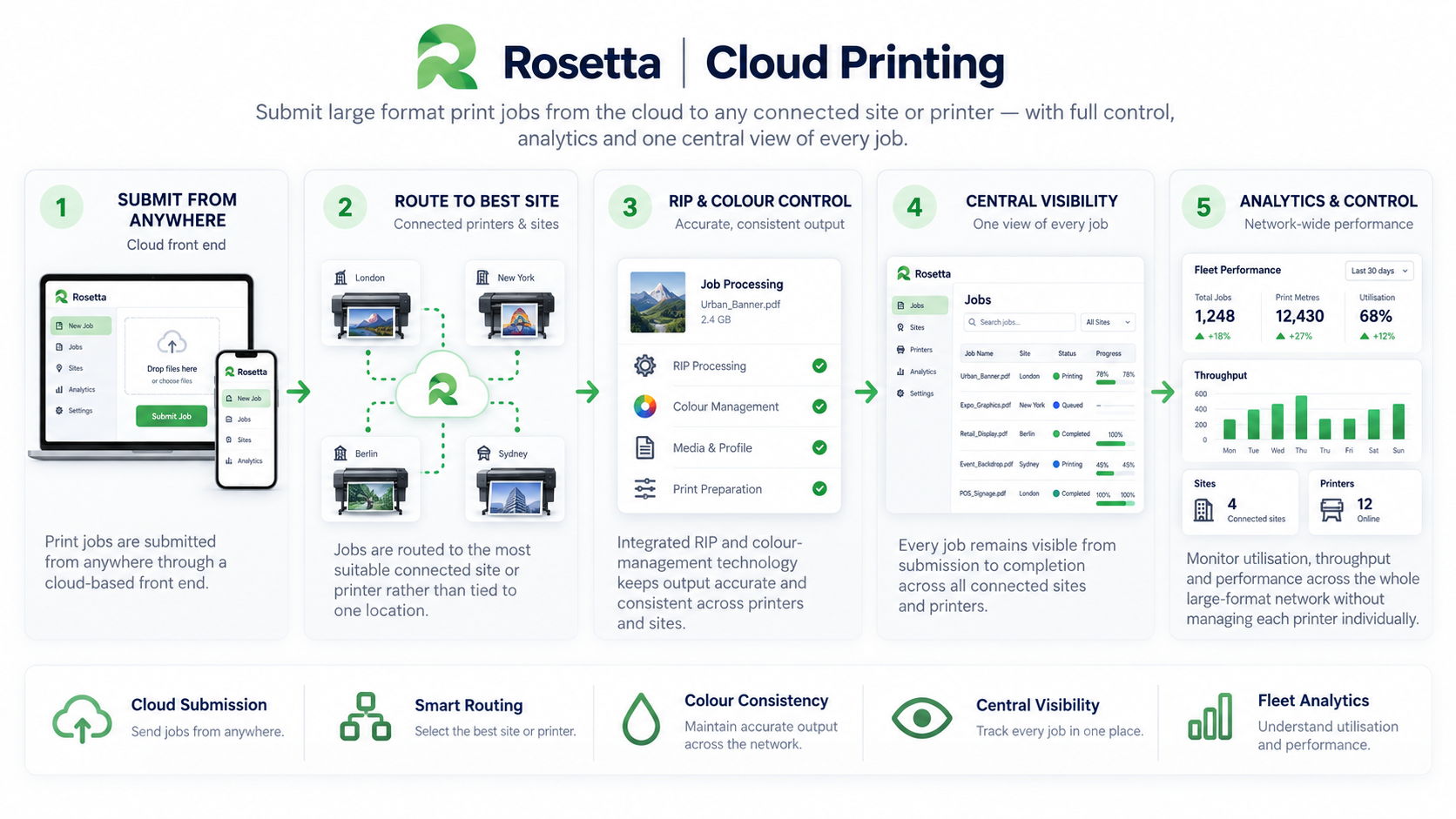
Rosetta gives large format printing a cloud front end: print jobs are submitted from anywhere and routed to whichever connected site or printer is best placed to produce them, rather than being tied to one physical location or device. Underneath, the same RIP and colour-management technology used across the platform keeps output accurate and consistent, whichever printer or site the job actually runs on.
Every job stays visible from submission through to completion, giving a single point of access across every connected site and printer rather than separate, disconnected views per location. That visibility extends into analytics — utilisation, throughput and performance across the whole large format network — giving full control over a fleet of printers without needing to manage each one individually.
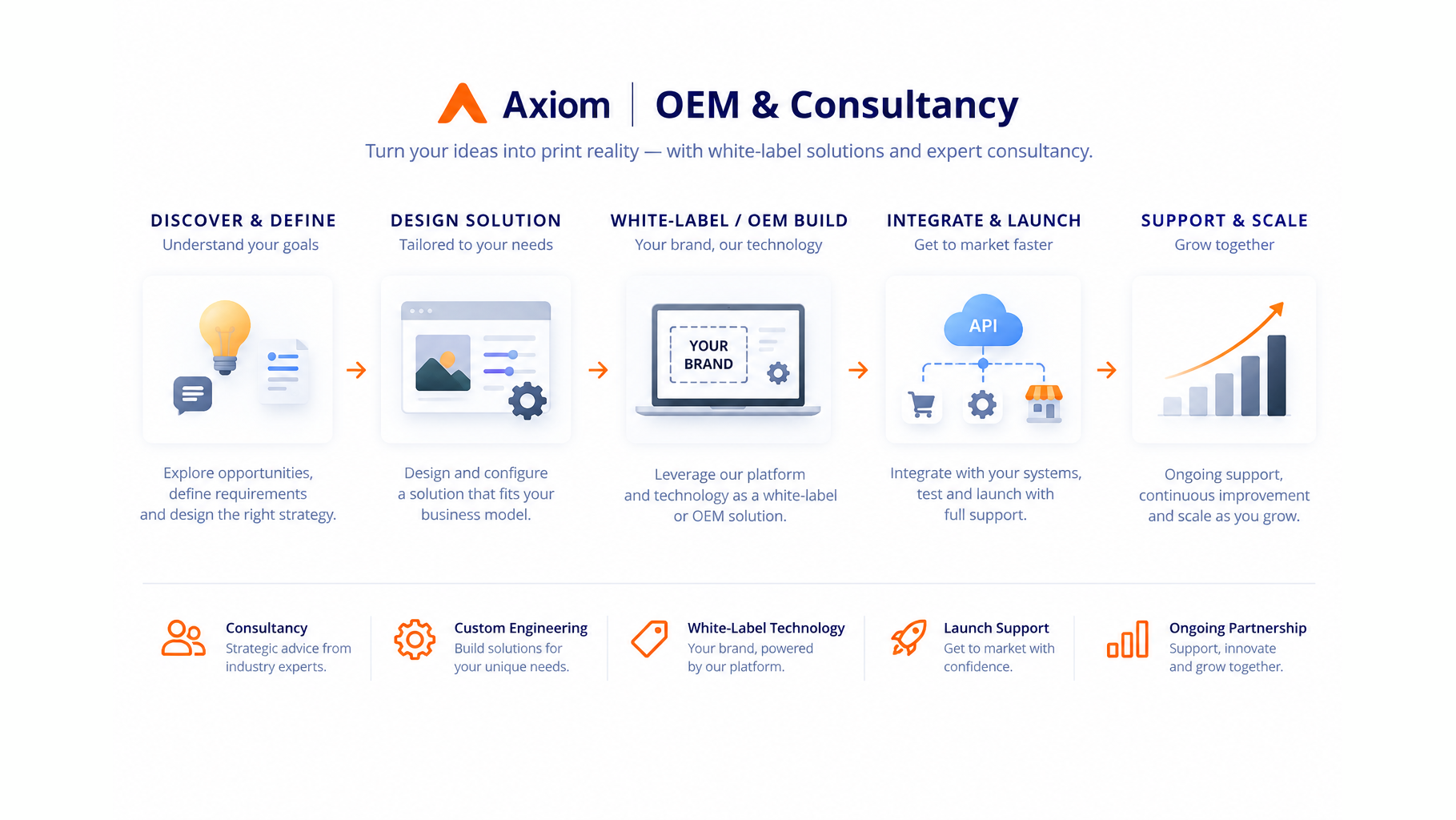
Axiom covers two distinct ways of working with Cloudstore beyond using the platform directly. The first is OEM: any solution or technology across the platform — Nexus, Pulse, Orbit, or the underlying Cloudstore Central technology itself — can be white-labelled and offered under another company's own brand, so a partner can put their name on proven technology rather than building and maintaining it themselves.
The second is consultancy: drawing on Cloudstore's own experience running print commerce operations to help a business design, plan and launch one of its own — whether that means choosing the right combination of solutions, scoping an integration, or working through how a new print operation should actually be structured before committing to it.
Your opportunity
Tell us about your content, sales channels and production needs, and we'll talk through where Cloudstore could fit.